
Learning How to Win
A Lean, Internal Performance Manifesto for Learning How To Win
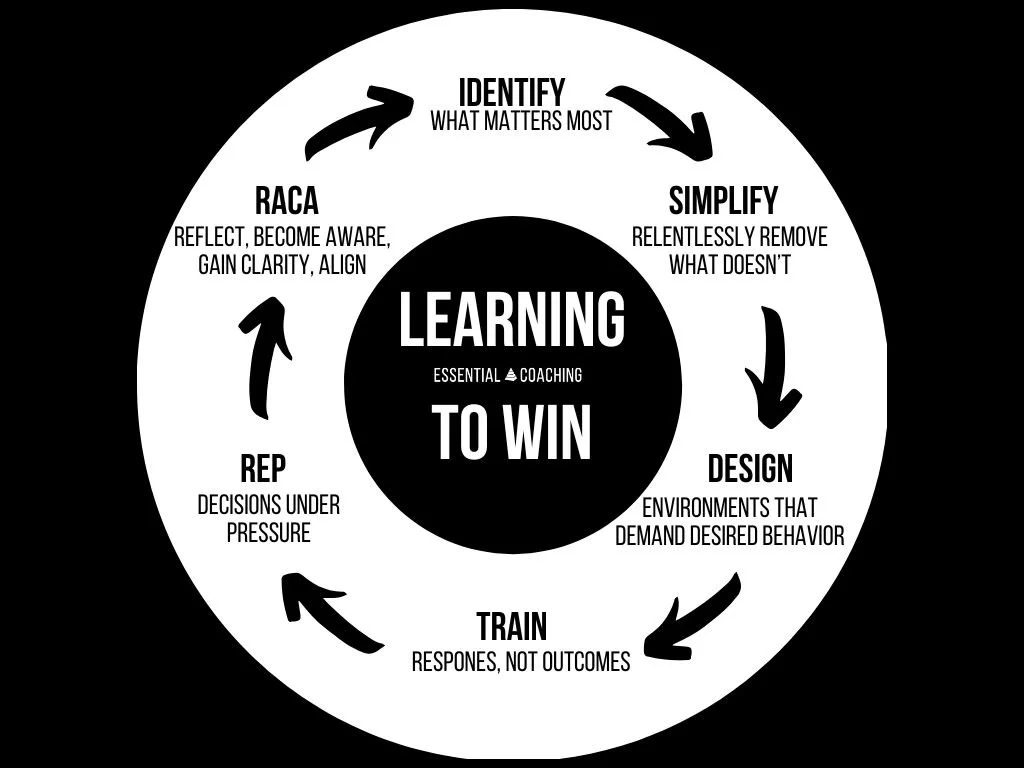
We don’t train the scoreboard. We train the behaviors that move it. outcomes improve as the cycle improves.
The Starting Point
We still use the word winning — deliberately.Winning matters. Avoiding the word doesn’t remove the pressure or the scoreboard; it simply leaves people to define winning for themselves.So we define it once — clearly — and then we move on.When we say winning, we are not talking about outcomes.
We are talking about the ability to respond well when things get hard.We believe winning is learned through a simple, repeatable discipline:Identify what matters most.
Simplify relentlessly.
Design the environment.
Train — and rep — response through decisions under pressure.From there, our language — and our work — shifts.The Thesis
Winning cannot be delivered.
It has to be learned.
We do not believe winning is taught through slogans, motivational talks, or borrowed success stories. Winning is learned through clear priorities, disciplined decision-making, and practiced response — especially when conditions are hardest.Our responsibility as leaders is not to perform belief or outsource motivation.
Our responsibility is to design environments that train response and create decision-making reps when it matters most.Core Definition
Winning is learned by identifying what matters most, simplifying relentlessly, and becoming consistent in our response and decisions when time, emotion, and choice are compressed.Put plainly:Performance improves when we clarify what actually drives success, eliminate what doesn’t, and rep the next best decision under pressure.This work is not about fixed traits, talent ceilings, or predetermined outcomes.
Response, decision-making, and competition are skills — and skills improve with reps in the right environment.The Language Stack
To keep our thinking and conversations clear, we use a simple hierarchy:Winning is the headline.
Response is the reality.
Decisions are the mechanism.Winning shows up through response.
Response is revealed through decisions.Commitments matter — but decisions decide.
Behavior is revealed through decisions.
The only controllable in any moment is the next decision.This language moves us quickly from outcomes to behavior, and from intention to action.Why We Don’t “Teach” Winning
Teaching implies delivery.
Learning requires behavior change.
As educators, we know a simple truth:If no learning is taking place, teaching hasn’t happened.If behavior is not changing, leadership is not working.So the more accurate question is not:How do we teach winning?But:How do people learn to respond and decide better under pressure?How Winning Is Learned
People learn winning when the environment:Demands honest reflectionEliminates unnecessary complexityClarifies what actually mattersAligns standards with daily behaviorReinforces the next best decision under pressure
Winning does not live in intention.
It lives in response — and response improves through reps, not explanation.
Our Operating Philosophy: Essentialism and Simplicity
Winning is not about doing more.
Winning is about doing less — better.
The most effective programs:Identify what is most closely tied to performanceRelentlessly invest in those essentialsBecome even more relentless about eliminating what doesn’t matter
Simplicity creates speed.
Speed creates consistency.
Consistency under pressure is where winning lives.
Focus is a competitive advantage — and focus is a skill.Motivation Must Be Intrinsic — Competition Is a Skill
Winning cannot be learned by people who do not want to compete.Competition is not an attitude.
It is a capability.The desire to engage, improve, and respond well must come from inside the room. External motivation may create short-term compliance, but it cannot create ownership or sustain performance under pressure.We reject the idea that competitiveness is a fixed trait.Like leadership, communication, and decision-making:Competition is a skillSkills improve with repsReps must be earned, not borrowed
Competing well means staying engaged, responding productively to failure, and re-entering the fight quickly. Those behaviors can be trained — and must be repped.RACA: A Developmental Pathway for Learning How to Win
RACA — Reflection, Awareness, Clarity, Alignment → Congruence — is not a slogan or a checklist. It is a developmental pathway grounded in how people and teams actually learn.Like a GPS, progress requires knowing where you are before deciding where to go.Reflection creates truthAwareness reveals patterns and blind spotsClarity identifies what actually mattersAlignment turns priorities into behaviorCongruence is repeated execution of aligned decisions and responses
Congruence is not perfection.
Winning is not a destination.
Winning is a pattern of adaptation.
RACA is iterative, not linear. Each cycle sharpens understanding, improves alignment, and strengthens execution under pressure.Why We Lead With Questions
People don’t need better answers.
They need better questions — in their own context.
Reflection is disciplined, not emotional.We ask:What actually happened?What decision was made?What response showed up?What mattered most?What will we do differently next time?
When people discover their own solutions:Ownership replaces comparisonCapability replaces dependenceDecisions stick because they’re earned
That is learning.
That is leadership.
Decisions Are the Unit of Winning
Commitments matter — but decisions decide.Within our program:Commitments show up as behaviorBehavior is revealed through decisionsThe only controllable in any moment is the next decision
Winning is learned moment by moment, not meeting by meeting.Decisions improve the same way any skill improves: through intentional reps in demanding conditions.These Are Not “Team Building” Sessions
This work is often mislabeled as team building.
It is not.
These are skill-development environments designed to create real decision-making reps.People are placed in uncertain situations where they must:DecideExperience consequenceReflectAdjust
This cycle — decide, experience, reflect, adjust — is how skill is built.Confidence is earned through repetition.
As reps accumulate, response improves under pressure.This is how individuals and teams become anti-fragile — better because of challenge, not protected from it.Why “When Things Get Hard” Matters
Most people define winning in ideal conditions:When confidence is highWhen momentum is on your sideWhen outcomes are cooperating
But winning is revealed:When fatigue hitsWhen adversity shows upWhen pressure compresses time and choice
Anchoring winning to when things get hard:Makes it situational, not theoreticalShifts focus from emotion to responseTreats resilience as a skill, not a traitAvoids false positivity without saying the words
This language communicates toughness, realism, and credibility.The Importance of Internal
Sustainable performance requires leadership that is:Continuous, not episodicContextual, not genericPresent, not outsourced
If someone else takes the reps, they get better — not us.By keeping this work internal:Learning stays contextualSkill stays transferableConfidence stays earnedWinning becomes sustainable
Our Principles
People first → people build teamsConnection before challengeSimplicity before complexityBehavior before outcomesDecisions before slogans
The Bottom Line
We still care about winning.We just define it by response —
and we train it by designing environments and repping decisions.We do not outsource belief.
We do not manufacture motivation.
We do not confuse activity with development.We design environments where:Competitive people sharpen skillsDecisions are repped under pressureOwnership replaces dependenceResponse improves over time
We don’t teach winning.
We build systems where winning is learned.
And that is how we create lasting, sustainable competitive advantage.